
Face Painters: You’re Leaving Money on the Table. Here’s the Fix.

You’re good at what you do. You can turn a five-year-old into a tiger in under three minutes flat. You’ve got a line at every birthday party you work.
But here’s the problem nobody’s telling you.
You’re capped.
There are only so many faces you can paint by hand in an hour. There are only so many months a year your paint doesn’t melt off in the heat. And there’s an entire customer base walking right past your booth because they think face painting is “for kids.”
Airbrushing fixes all three. And a lot of face painters are already figuring that out.
The Face Painters Who Already Called Us
We didn’t go looking for this audience. They found us.
At Airbrush Events, our founder gets messages constantly from face painters and body artists who’ve hit the ceiling of what a brush and sponge can do. They already have a client base. They already have the artistic eye. What they don’t have is the tool that lets them turn that skill into more bookings, bigger events, and higher rates.
That’s exactly why we built Airbrush Events Academy. Not necessarily for people starting from zero. For artists like you who are one skill away from a completely different business.
Airbrushing Isn’t a Replacement. It’s a Multiplier.
Let’s kill a myth right now: airbrushing doesn’t replace your brush skills. It stacks on top of them.
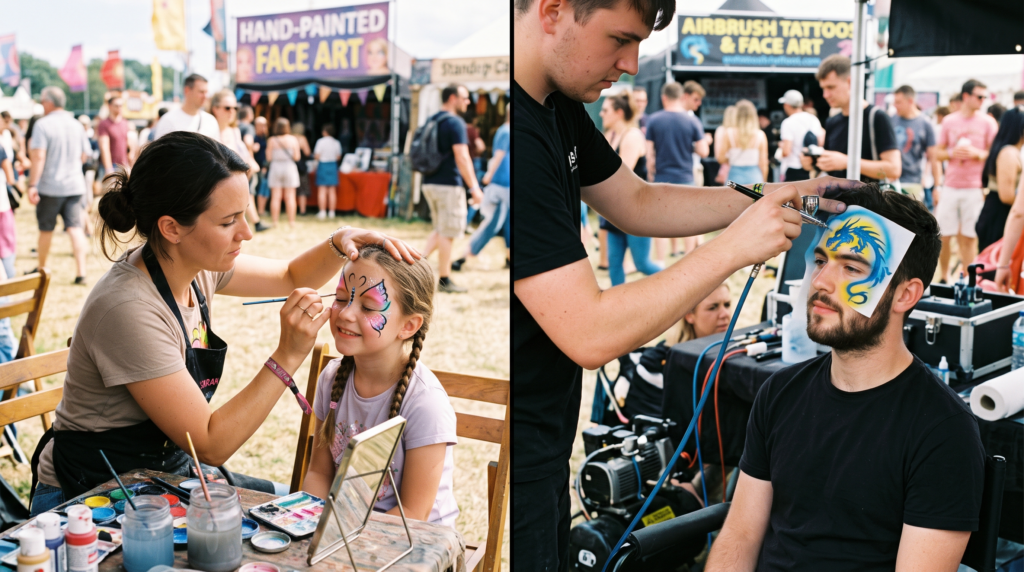
Think of it as a fancier brush, not a different job. You’ll still use your hand skills for detailed work. But now you’ve got a second tool that does the one thing your brush can’t: speed and scale.
Here’s what that actually means in numbers.
Speed: A skilled hand painter does about 10 to 15 faces an hour. With an airbrush and stencils, that jumps to 20, 30, even 40+ per hour. One artist we know puts it simply: she paints “2 to 3 people to every one” a hand painter does at the same festival. Customers see the shorter line and walk straight to her.
Money: Traditional face painting private parties run about $50 to $100 an hour. Airbrush art routinely commands $200 to $300 an hour, sometimes with a coverage area that’s double the size. Same event. Same hours worked. More on the invoice.
Season: Water-based face paint sweats off in the heat. It’s why a lot of face painters watch their bookings die every summer, right when festivals, pool parties, and outdoor events are at their peak. Waterproof airbrush formulas solve that. You stop losing your busiest season to the weather.
Audience: Kids get their faces painted. Teens and adults don’t, usually, but they will absolutely get an airbrush tattoo on their arm or shoulder. That’s not a small niche. Airbrush tattoos alone make up over 40% of the entire temporary tattoo market, a market that’s on track to more than double in size over the next decade. Adults are now the majority of buyers, not kids. That’s an entire customer base most face painters never touch.
What You Can Actually Sell Once You Learn This
This isn’t just “airbrush tattoos.” Once you’ve got the skill, here’s what opens up:
- Airbrush tattoos and body art for teens, adults, and events that hand face painting can’t reach
- Custom stenciled designs that let you paint fast without sacrificing consistency
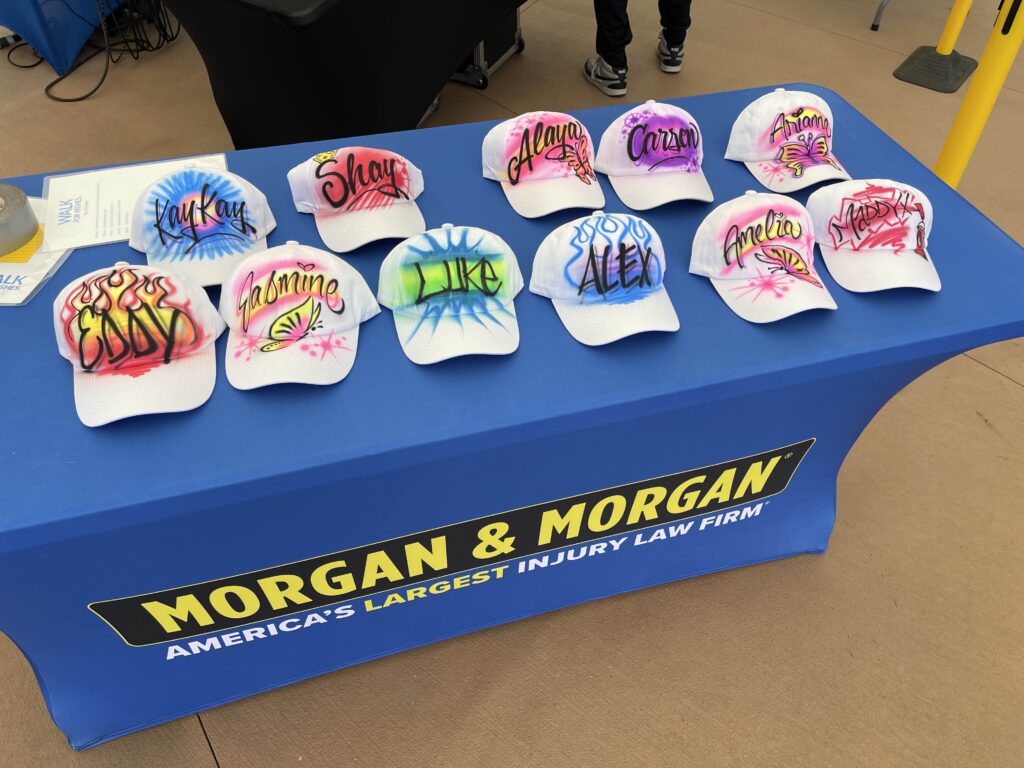
- Merchandise airbrushing on T-shirts, hats, and totes, which means party favors and swag people actually keep
- Corporate event branding, where you’re airbrushing logos onto guests who become walking advertisements for the brand that hired you
- Higher-volume events like festivals, corporate picnics, and grad nights that pay better and need faster throughput than you can currently deliver
Every one of these is a new revenue line sitting on top of the business you already have.
Why Most Face Painters Who Try This Alone Get Stuck
Here’s the part that matters most, and the part almost nobody tells you.
Airbrushing looks simple. Point, spray, done. It’s not.
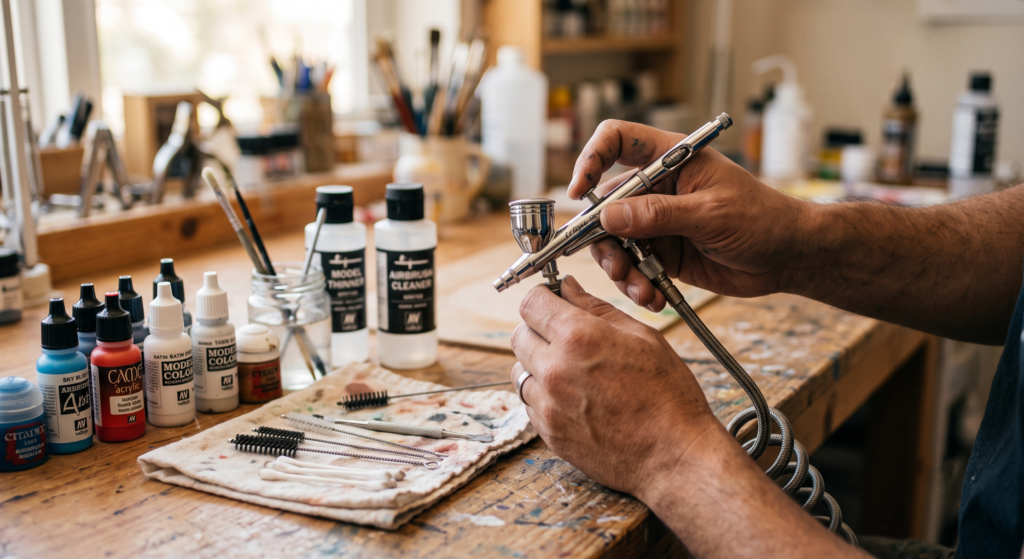
The artists who try to teach themselves off YouTube usually hit the same wall: clogged nozzles, paint that’s too thick or too thin, wrong air pressure, and gear that fights them the whole way. One industry source that reviewed airbrush tutorials online found the vast majority contained bad information, especially around color and maintenance. You end up blaming your talent when the real problem is the tool, or the technique nobody showed you correctly.
We’ve watched this play out with our own trainees. One of our team members tracked his own progress and logged roughly 80 hours of practice before he was ready to work a live event. Another went from zero to confident freehand lettering in about two months. Both did it with structured coaching and direct feedback on their actual work, not a random video that may or may not be correct.
That’s the entire gap between “I bought an airbrush and it’s collecting dust” and “I added a $250-an-hour service to my business.” It’s not talent. It’s training.
What You Actually Need to Get Started
You don’t need a garage full of equipment. You need:
- A solid dual-action airbrush (skip the cheap starter kits, they clog and hold you back)
- A compressor that holds steady pressure, ideally with a tank so the air doesn’t pulse
- The right paint for the job Non-toxic, water-based for kids and easy cleanup, ink-based for waterproof tattoos and body art
- Stencils to help you move fast without losing quality while you’re building speed
- Someone who’s actually done this professionally to tell you what you’re doing wrong before you’ve wasted 80 hours guessing
That last one is the difference between weeks and months.
The Bottom Line
You already have the hardest part. Painting is the hard skill, and you’ve got it. Clients already trust you. You know how to work a booth and manage a line.
Airbrushing isn’t a career change. It’s an upgrade to the business you’re already running: more people served per hour, higher rates per person, a season that doesn’t shut down in the heat, and customers you currently can’t sell to at all.
The artists asking us about this aren’t beginners. They’re face painters who did the math and realized the ceiling on hand painting was a lot lower than the ceiling on airbrushing.
If you’re already good with a brush, you’re closer to this than you think.
Ready to see what airbrushing could add to your business? Airbrush Events Academy was built for artists exactly like you.
FAQ
Do I need to already know airbrushing to work events with a face painting background?
No. Most face painters who add airbrushing start with zero airbrush experience. Your existing color theory, composition, and hand-eye coordination transfer directly. What you’re learning is the tool, not the art.
Is airbrush face and body art safe and does it use the same paint as face painting?
Airbrush artists use cosmetic-grade, skin-safe paints made for the purpose, similar in safety standard to traditional face paint but formulated to run through an airbrush gun. Water-based, hybrid, and tattoo-ink formulas each have different wear times and uses.
How long does it take to get good enough to work a real event?
It varies, but real-world data from trainees puts it around 80 hours of focused practice to reach event-ready confidence, faster with structured coaching and feedback than self-teaching alone.
Can airbrushing be added to an existing face painting business, or does it require starting over?
It’s an add-on, not a restart. Most artists keep doing hand painting for detailed kids’ work and bring in airbrushing for tattoos, body art, faster throughput, and adult clients.