
“I’m Not Artistic Enough” – And Other Lies Keeping You From Learning to Airbrush

The skill vs. talent debate, imposter syndrome, and what it actually takes to start.
Let me tell you what happened the day I decided to make a macrame plant holder.
I had made them before – many times, actually. About a decade ago, I was in a full creative streak. I was writing constantly (I seriously considered writing a book). I was making macrame holders and hanging them everywhere. I was giving handmade rings and bracelets to people faster than I could make them. Creativity was not something I thought about – it was just what I did.
Then life got louder. A move. A growing business. The things that tend to crowd out the things you love.
Fast forward to recently, when I finally had some breathing room again. I dug out my supplies, fully expecting to just pick up where I left off. After all, I had done this so many times before.
I could not remember a single knot.
Not one. I could not even remember how to begin. I stood there looking at the cord like it was a foreign language.
And here is where the sneaky lie crept in: Maybe I was never actually good at this. Maybe I just convinced myself I was.
Sound familiar?
The Lie That Stops People From Ever Starting
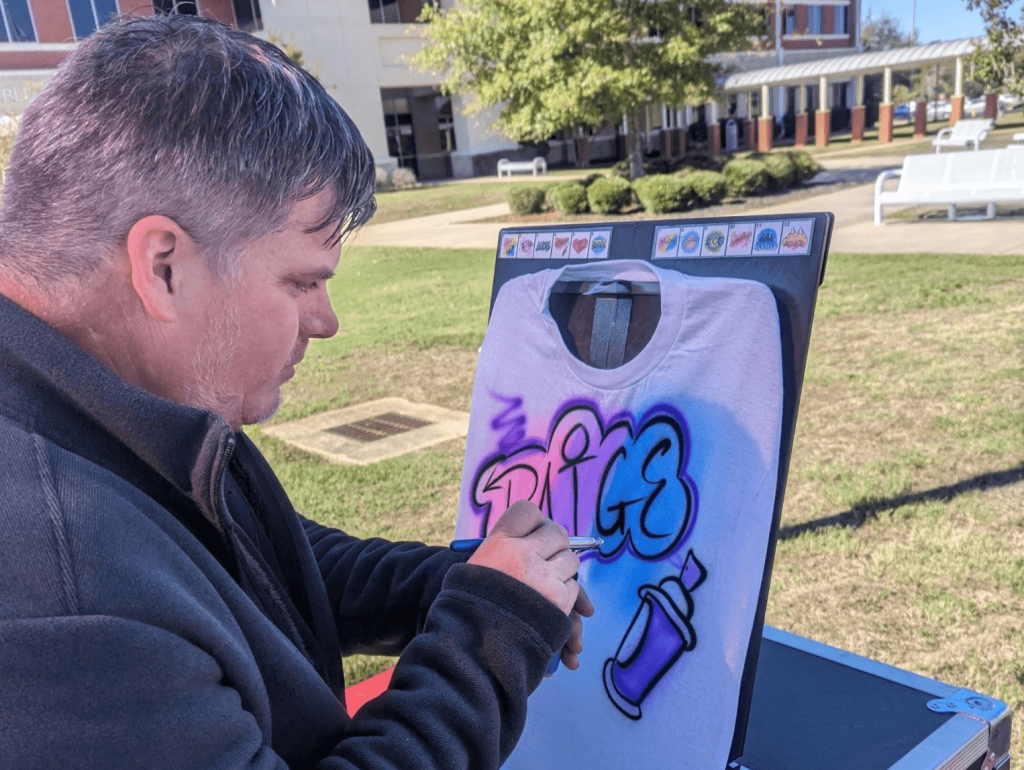
If you have ever watched an airbrush artist transform a plain white t-shirt into something jaw-dropping – and thought, I could never do that – you have met this lie.
It shows up dressed as self-awareness. But it is not. It is fear wearing the costume of honesty.
It sounds like:
- “I don’t have a natural eye for color.”
- “I can’t draw a straight line.”
- “Other people are just wired for this. I’m not.”
Here is what I have come to understand: that voice is not telling you the truth about your talent. It is telling you the truth about where you are right now – which is a very different thing.
“Not artistic enough” is not a fixed state. It is a starting point.
What Skilled Artists Actually Know (And Have Forgotten)
When someone has been airbrushing t-shirts professionally for years, something interesting happens: they stop thinking consciously about the individual steps.
They do not think: lighter pressure here, more distance there, this color before that one. Those decisions have moved from the front of the brain to the back. They have been internalized. Automated.
Which means if you asked an experienced artist to explain exactly how they do what they do, they might pause. Not because they do not know – but because their hands know it before their mouth does.
That is not a gap in ability. That is what mastery looks like.
The beginner, by contrast, is intensely aware of every step. Every choice. Every mistake. And that hyper-awareness feels like incompetence – but it is actually just the starting point that every skilled artist has stood at.
“But Would I Even Know Which Colors Go Together?”
This question comes up a lot – and it is a fair one.
Honest answer: probably not yet. But neither did anyone who now does.
Color intuition is not a gift. It is a pattern your brain learns from seeing – from trying combinations, noticing what works, making something that looks off and figuring out why. Every artist you admire who seems to “just know” has a mental library of hundreds of experiments behind that instinct.
Nobody is born knowing which colors pop on a custom airbrush t-shirt. They learned it by doing. By painting. By getting it slightly wrong and then slightly less wrong until it clicked.
That is not talent. That is practice. And practice is something anyone can do.
There is actually solid research behind this — Stanford psychologist Carol Dweck has spent decades studying exactly why talent is learned, not fixed. Her TED Talk is worth 10 minutes of your time.
Back to My Macrame Moment
Here is what I realized standing there with a pile of cord I no longer knew how to use: I had not forgotten how to be creative. I had forgotten the mechanics of one specific skill I had not practiced in ten years.
Those are two completely different things.
The creativity that made me want to make things – to give people something handmade, to turn cord and knots into something beautiful – had not gone anywhere. It was sitting there, waiting. The knots just needed relearning.
And here is the thing about relearning: it goes faster than you think, because you are not starting from zero. You are starting from someone who already knows why they want to create.
That is an advantage, not a deficit.
You Don’t Need Permission to Be a Beginner
If you have been watching airbrush videos and thinking, that looks incredible but it is not for someone like me – I want to push back on that.
The question is not whether you have the talent. The question is whether you want to learn. Because the skill part? That is what instruction is for.
That is exactly what we built Airbrush Events Academy around: not the assumption that you already have it, but the belief that you can get there – with the right guidance, the right tools, and someone who actually knows how to teach airbrushing on t-shirts, step by step.
You do not need to be artistic enough to start.
You just need to start.
Ready to take the first step? Check out our coaching packages.
FAQ: Learning to Airbrush as a Complete Beginner
Can I learn to airbrush with no artistic background?
Yes. Airbrushing is a skill, not an innate talent. Most people who take professional airbrush training start with little to no prior experience. The key is learning proper technique from the beginning, which is exactly what one-on-one instruction is designed to do.
Do I need to know color theory before I start airbrushing?
No prior knowledge of color theory is required. Color intuition develops through practice. A good instructor will walk you through which colors work together and why as part of the learning process.
Is airbrushing on t-shirts hard to learn?
It has a learning curve, but it is very learnable – especially with live, one-on-one instruction rather than trying to figure it out alone from videos. Having a professional guide means you avoid the most common beginner mistakes from day one.
What equipment do I need to start learning to airbrush?
At minimum, you need an airbrush, a compressor, and the right paint. We take the guesswork out of this – our training includes guidance on exactly what to buy so you are not wasting money on the wrong gear.
How long does it take to learn airbrushing?
That depends on how much you practice and how you learn. With structured one-on-one instruction, most students see meaningful progress much faster than they expect – because they are learning the right habits from the start rather than unlearning bad ones later.
Still on the fence? Read: Why Learn Airbrushing? A Guide to Creative Freedom and Profit